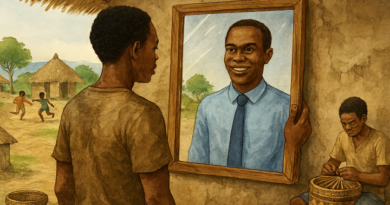

Why I love Corporate Communication
As a journalism and mass communication student, my greatest ambition was simple and clear: to tell compelling stories. I envisioned myself on Kenyan television screens, known for engaging, factual, and articulate narration of Kenyan and African realities. I was particularly drawn to human interest stories, convinced that these were the stories most Kenyans wanted to hear, see, and read.
I greatly admired journalists who embodied this craft. At the top of my list was Mohammed Ali of the Standard Group, whose Jicho Pevu investigative exposés were both fearless and transformative. His work did more than uncover truths; it ignited national conversations and challenged systems of power.
I also looked up to Salim Kikeke of BBC Swahili for his command of language and storytelling, as well as the late Professor Ken Walibora, whose literary contributions shaped my appreciation for authentic African narratives.
From early on, I had my eyes set on the bigger picture. I deliberately honed my speaking and writing skills in preparation for a career in journalism. Books were constant companions as I sought to master the Queen’s English and sharpen my articulation.
I often listened to Professor PLO Lumumba’s speeches, drawn by his depth, clarity, and intellectual rigor. For anyone who follows him, it is evident how much wisdom one can draw from his oratory and worldview.
At university, our course was structured into two majors: print and broadcast media, and public relations. From day one, I chose the mainstream media path. As the son of Mr. and Mrs. Okoth, I was resolute in my decision, and little could persuade me otherwise. At the time, public relations was a distant concept to me.
What I knew about it came largely from popular culture, particularly the television series “Scandal”, where PR appeared to revolve around crisis management and manipulating public perception. I did not imagine that this would eventually become my professional calling.
That changed following a deeply painful chapter in my life: the death of my younger brother. He was only five years old.
My brother lived with a rare blood disorder, complex, difficult to diagnose, and incurable. Doctors explained that it could only be managed, meaning that hospital visits would be a constant part of his life. For a long time, accurate diagnosis proved elusive, as many medical professionals struggled to identify the condition.
Clarity finally came after he was enrolled in a school within our locality that was supported by a non-governmental organization. The NGO served underprivileged members of the community, including key populations and families affected by HIV/AIDS, with a strong focus on education and healthcare. In addition to providing quality education, the organization ran a hospital where residents accessed medical services at subsidized costs.
It was at this hospital that my brother was properly diagnosed and received most of his treatment. Compared to other facilities, it was a place our family could afford, a relief that cannot be overstated. The care was professional, compassionate, and dignified. Sadly, despite the best efforts of the medical team, the illness took its toll, and my brother passed away.
In the midst of grief, I felt compelled to act. A few weeks after his burial, I made the decision to tell the organization’s story. With the support of my colleagues and course mates, I scripted and produced my first documentary featuring the organization. That project marked my introduction to the world of corporate and development communication, though I did not fully realize it at the time.
Two years later, I received an invitation to apply for a Corporate Communication Officer position at an NGO. One of the application requirements was a link to a sample of previous work. The documentary I had produced became my entry point. It opened the door and, ultimately, earned me my first professional role.
As time passed, my interest in mainstream media gradually diminished. One significant factor was the growing number of redundancies within major media houses, which made the field increasingly unstable. The path I once admired no longer held the same promise.
Corporate communication, on the other hand, introduced me to a new dimension of storytelling. It gave me the opportunity to use communication as a tool for social change, to promote sustainable development, inclusivity, social cohesion, awareness, and education. Through this work, stories are not told for headlines alone, but to influence policy, mobilize resources, and transform lives.
Today, I aspire to be part of teams that write grants and document impact stories that inspire donors and investors to channel resources toward community development. My brother’s story remains a powerful reminder of the vital role NGOs and civil society organizations play in underserved communities. Communication within these spaces is not peripheral; it is central to making impact visible and change possible.
So, if you ever ask me why I chose and love corporate communication, this is my answer.