Why I chose Kakamega
The scent of damp earth and grilled maize fills the air on this Saturday evening.
A gentle shower has recently ended, leaving the pavement shiny under a cover of trees. Motorcycles buzz by in harmony, their engines and laughter merging with gospel tunes from a church close by. It’s my regular walk, the one that leads me through known paths adorned with kiosks, little stores, and the calm, enduring vibe that characterizes Kakamega.
A friend inquired once more, as they frequently do, why I decided to reside here. Why, with a profession that links me to narratives throughout Africa, would I settle in this town in western Kenya?
I always grin, aware that for numerous individuals, Kakamega remains a figment, perceived as tiny, far away, and insignificant. Yet, each stride I make reminds me that what individuals refer to as “the periphery” may be more pivotal to life than they realize.
The question, I’ve come to realize, isn’t really about Kakamega.
It’s about Kenya’s mental map, one that places Nairobi at the center and everything else at the edge. For decades, the capital has been seen as the only serious place to live, to work, to succeed. From education to business, ambition has often meant migration toward that skyline.
But as I walk these streets, I see a quiet defiance of that idea.
Kakamega is changing, and so are the people who choose it.
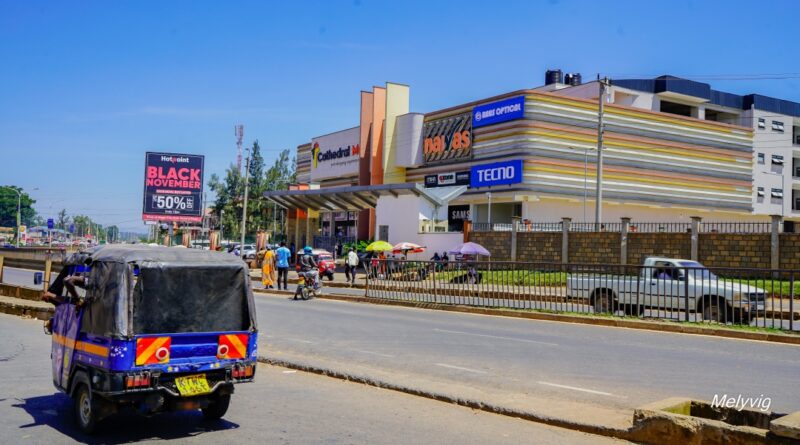
When I first arrived in 2016 as a university student, I wasn’t thinking about decentralization. I was simply looking for a place to belong. The town was calm and grounded in its own rhythm. Almost a decade later, it hums with new ambition. Small malls and office blocks rise where open fields once stood. Cafés serve cappuccinos alongside chapati. Co-working spaces are filled with students, freelancers, and young entrepreneurs who are learning that opportunity can grow anywhere.
Yet the soul of the town hasn’t changed. It’s still green, affordable, and human.
I can write a story from my balcony with the sound of birds in the background. I can walk to the market and greet people by name. I can pause mid-morning and watch the rain sweep across the valley without feeling I’m losing time. There’s a rhythm here that doesn’t demand exhaustion to prove your worth.
Kakamega County has a population of approximately 1.9 million individuals. The local authority has been funding initiatives that showcase both foresight and assurance, including a referral hospital, a modern stadium, a bulk-water project, and new university facilities. These are the signs of a thriving town rather than a dormant one.
Governor Fernandes Barasa has often said that the county will continue to “enhance optimal use of available resources to improve the quality of life for residents.” It’s a promise that feels visible on the ground, in the hospitals being expanded, the new roads being laid, and the quiet determination that defines daily life here.
When friends from Nairobi visit, they often laugh at how simple life seems here. They measure value by pace, by noise, by visible urgency. But simplicity isn’t absence. It’s balance. Kakamega offers what many big cities are trying to recreate through planning and policy, livability.
Nairobi thrives, yes, but it also strains. It carries the weight of being the country’s default center of everything, economy, culture, opportunity. Rent prices alone can drain creativity. A one-bedroom apartment that costs forty thousand shillings there costs less than half here. Food is fresh, traffic is minimal, and the internet is reliable enough to keep me connected to editors and colleagues across the continent.
Kenya’s transition to digital has enabled this way of life. The country now has over seventy-six million mobile subscriptions, meaning that connectivity is nearly universal. It’s proof that meaningful, connected work no longer depends on location. A journalist in Kakamega, a designer in Kisumu, or a filmmaker in Eldoret can reach the world from wherever they are.
Urban scholars have long recognized the potential of such towns. The World Bank has noted that “secondary towns have an important role to play in Kenya’s economic development.” Similarly, Cities Alliance urban planner Brian Roberts describes these towns as “the emerging engines of the rapid-pace urbanization the world will experience in the decades ahead.”
Nevertheless, only a few people discuss what this shift means for how we think.
When we concentrate everything, talent, opportunity, imagination, in one place, we create a hierarchy of belonging. Those in smaller towns are often seen as waiting, as if their real lives will begin only after they relocate to the capital. That mindset limits not just mobility but imagination itself.
Kakamega challenges that.
It invites you to build rather than chase. It teaches that growth doesn’t have to mean congestion, that progress can coexist with calm. From here, I’ve written stories about the continent’s biggest shifts, from Lagos to Cape Town, while surrounded by forest light and the steady heartbeat of a town growing at its own pace.
The story of Kakamega fits into a larger movement. Across Kenya, secondary towns are becoming new centers of gravity. Nakuru has earned its city status and is attracting investors once confined to Nairobi. Eldoret is expanding its industries. Kisumu’s creative and tech scenes are thriving. Development in Kenya is no longer a straight line pointing toward the capital. It’s a web of opportunity that stretches across the country.
Urbanist Edgar Pieterse once remarked that African cities are “not just about doom and gloom.” They are, in fact, sites of possibility and reinvention, places where new models of growth are being written every day. Kakamega, in its own way, is one of them.
But decentralization isn’t only about infrastructure. It’s about mindset, about who gets to define relevance. It’s about imagining a Kenya where people can build meaningful, connected lives wherever they are. A young designer can launch a brand from Kakamega. A filmmaker in Kisumu can screen their work to the world. A journalist can tell African stories from home and still be part of the global conversation.
Every walk reminds me of this truth. The same route, different light each week. The sound of school bells, the smell of sugarcane, the rhythm of people who still wave even when they don’t know your name.
The question “Why Kakamega?” no longer needs an answer.
I don’t feel the need to explain what has become home. Instead, I see it as an invitation, to look closer, to think wider, and to see value where others overlook it.
Maybe the future isn’t about escaping the periphery.
Maybe it’s about realizing that the periphery was never peripheral at all.